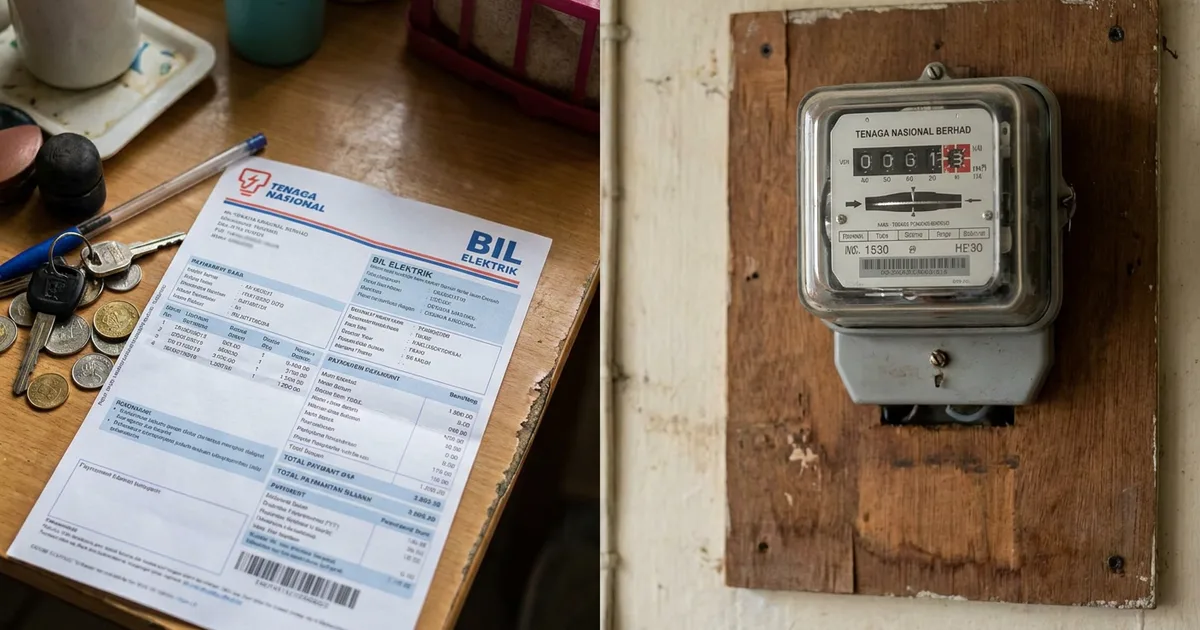
If your May or June 2026 TNB bill came in higher than expected, you are not imagining it. May 2026 is the first month the Automatic Fuel Adjustment, or AFA, has added to bills rather than discounted them since TNB restructured its tariff in July 2025. Most people never got told why their bill moved, so they assume they used more power. Often they did not, and this TNB calculator guide shows you exactly what changed.
What follows is a plain TNB calculator in words. You will get the exact formula TNB now uses, two worked examples in real ringgit and kWh, a benchmark for what a normal Malaysian bill looks like, and the part no official tool gives you: how that same bill figure translates into a solar saving estimate. Most calculators stop at the number. This one shows you what to do about it.
One thing worth knowing as you read: every figure below is written from your side of the table. SolarCompare.my has no system to sell you, because we are not an installer. We match you with up to three SEDA-registered installers who compete for your job, so the maths here is yours to use, with or without us.
What Changed on Your TNB Bill in July 2025
For decades TNB charged domestic users on tiered block rates. The more you used, the higher the rate on each extra unit. Block 1 (1 to 200 kWh) cost 21.80 sen per kWh, Block 2 (201 to 300 kWh) cost 33.40 sen, Block 3 (301 to 600 kWh) cost 51.60 sen, Block 4 (601 to 900 kWh) cost 54.60 sen, and Block 5 (901 kWh and above) cost 57.10 sen. A heavy-use household paid a punishing rate on its top units.
From July 2025 that system was scrapped. TNB moved to a flat generation charge: 27.03 sen per kWh for all usage up to 1,500 kWh a month, and 37.03 sen per kWh on anything above that. Simpler to read, but Paul Tan reported it as a 13.64% base tariff increase for mid-to-high usage homes. The split is worth understanding before you blame yourself for a higher bill. Heavy users, who once spread their usage across cheaper early blocks, now pay the full rate on every unit and lost out. Homes that stay at or under 600 kWh came out roughly neutral, because they sit below the line where the new monthly surcharge even applies.
The second change matters just as much. The old Imbalance Cost Pass-Through (ICPT), which adjusted bills only twice a year, was replaced by the monthly AFA. Fuel price swings now flow into your bill every single month instead of every six. The practical result is a bill that is far easier to calculate but more variable month to month. For the full breakdown of what the new structure means for your household, see our TNB new tariff guide.
How to Calculate Your TNB Electricity Bill in 2026
The 2026 tariff makes this simpler than it used to be. A working TNB bill calculator now has only two moving parts: the generation charge and the AFA charge. For a household using under 1,500 kWh a month, the formula is:
Bill = (kWh used × 27.03 sen) + AFA charge
AFA charge = 0 if you use 600 kWh or less
AFA charge = (kWh used − 600) × the month's AFA rate, if you use more than 600 kWh
The detail that catches people out is the 600 kWh line. The AFA only ever touches the portion of your usage above 600 kWh. If you use 600 kWh or less, the AFA is waived completely, a deliberate protection for lower-usage homes. For May 2026 the AFA rate is +1.38 sen per kWh on that upper portion. This figure changes monthly, so check mytnb.com.my for the current rate before you rely on it.
The formula works the same on any household, so take two real examples. This is exactly what searchers in Malaysia mean when they look up cara kira bil elektrik or pengiraan bil elektrik.
Example A, a smaller home using 500 kWh in May 2026. Generation charge: 500 × RM0.2703 = RM135.15. AFA: waived, because usage is under 600 kWh. Estimated bill: about RM135.15.
Example B, a family home using 800 kWh in May 2026. Generation charge: 800 × RM0.2703 = RM216.24. AFA: (800 − 600) × RM0.0138 = 200 × RM0.0138 = RM2.76. Estimated bill: about RM219.00.
One honest caveat. This formula covers the two charges that drive your bill, but a real TNB invoice also adds a fixed service charge and a Renewable Energy Fund levy, and may add other small line items. For the exact final figure including those, use the official myTNB bill calculator. For tracking the current tariff and AFA rate, Paul Tan’s TNB calculator is the most reliable independent source.
What Is a Normal TNB Bill? Benchmarks by Household Size
The real question behind most calculator searches is unspoken: am I paying too much? Malaysia’s average electricity use runs at roughly 437 kWh per person a month, drawn from World Bank per-capita figures. Scale that by how many people share your home and you get a workable benchmark.
Using the 27.03 sen generation charge, before any AFA, the rough tiers look like this:
- A one or two person home typically uses 300 to 500 kWh, which lands around RM81 to RM135 a month. The AFA is usually waived or barely applies.
- A family of four often uses 600 to 900 kWh, roughly RM162 to RM245 a month on the base charge. This is where the AFA starts to bite, since usage crosses the 600 kWh line.
- A high-use household leaning hard on air conditioning can hit 1,000 to 1,500 kWh, about RM270 to RM406 a month on the base charge alone.
Air conditioning is the single biggest swing factor. A typical 1.5HP unit running eight hours a day adds roughly 250 to 300 kWh a month on its own, enough to push a comfortable home straight into AFA territory. Treat these as estimates, not invoices. Your actual bill shifts with your appliance mix, how many people are home during the day, and whether you have opted into the Time-of-Use tariff.
The AFA Explained: Why May 2026 Bills Went Up
This is the charge behind the bill that surprised you. The AFA replaced the biannual ICPT and passes TNB’s fuel cost changes to you every month. When fuel is cheap it shows up as a rebate and your bill dips below the base charge. When fuel is expensive it is a surcharge and your bill climbs.
For the first four months of 2026 the AFA was a rebate every month: −4.99 sen per kWh in January, −2.77 in February, −2.15 in March, and −0.47 in April. Bills sat slightly below the headline tariff and nobody complained. Then in May 2026 the AFA flipped to +1.38 sen per kWh, the first surcharge since the July 2025 restructure. Paul Tan attributed the swing to rising global fuel prices feeding through to power generation.
The damage is smaller than the headlines suggest, because the AFA still only touches usage above 600 kWh. The 800 kWh household from earlier paid about RM2.76 extra in May. The point is the direction of travel, not this month’s ringgit. The AFA is now pointing up, and it is reset every month, so check paultan.org or mytnb.com.my for the live rate.
From Your TNB Bill to Solar Savings: The Calculation
Here is the bridge no official calculator builds for you. You know your bill in ringgit. To know what solar could save you, you first need it in kWh, then matched to a system size. It is three short steps.
Step 1: turn your bill back into kWh. Reverse the formula. For usage under 1,500 kWh, divide your bill by the generation rate: RM bill ÷ 0.2703 gives you a close estimate of your monthly kWh. A RM300 bill works out to roughly 1,110 kWh a month. Most people never know this number, and it is the one that actually drives a solar quote.
Step 2: match kWh to a system size. A 5kW solar system in Malaysia generates around 1,000 to 1,200 kWh a month given typical sun hours. So a home using about 1,110 kWh is a natural fit for a 5kW system. See our solar panel guide for how to match system size to your roof and consumption.
Step 3: estimate the saving under Solar ATAP. Most households earn export credits of about RM0.27 per kWh, the same rate as the generation charge for sub-1,500 kWh users. If 80% of what your panels generate offsets power you would otherwise import, a 5kW system covers roughly 880 to 960 kWh of imports. At RM0.27 each that is about RM238 to RM260 saved a month.
Follow that through and the picture is clear. A RM300 monthly bill points to roughly 1,110 kWh of usage, suits a 5kW system, and could drop your bill to around RM40 to RM62, a net saving near RM238 to RM260 every month.
Payback on a typical residential system lands at five to eight years. Go bigger and the numbers scale: a 14kWp setup paired with a battery has been reported to save RM700 or more a month.
One rule keeps this honest. Under Solar ATAP, unused export credits do not roll over from one month to the next. Oversize your system and you simply give away the surplus. Right-sizing is everything, and the precise figure for your roof depends on space, orientation, shading, and your usage pattern, all of which need a real site visit from a SEDA-registered installer.
What Is Solar ATAP? (Launched January 2026)
Solar ATAP replaced Net Energy Metering (NEM) in January 2026. The headline difference is timing. NEM let credits carry forward, whereas Solar ATAP works on a same-month offset only. Your export credits reduce that month’s bill and anything left over is forfeited at month end. No rollover.
There is an upside to the switch. Solar ATAP has no quota, so you can apply at any time, unlike NEM’s capped application windows that closed once full. The one hard requirement is that only SEDA-registered installers can fit a system that qualifies for the scheme. An unregistered installer might quote cheaper, but their work will not be accepted, which makes that saving worthless.
For the full comparison of the two schemes and which applies to you, see our Solar ATAP vs NEM Rakyat guide.
Get Solar Quotes for Your Home, and Compare Them
The maths above is a starting point, not a final answer. A back-of-envelope estimate tells you whether solar is worth a serious look. The precise number only comes from a site visit, because a calculator cannot see your roof space, its orientation, the afternoon shade from next door’s tree, or when your household actually draws power. Those four things decide your real saving.
Three quotes do something a single quote never can: they show you the spread. One installer might size you at 5kW, another at 6.6kW, a third might push a battery you do not need. Lay them side by side against the RM238 to RM260 estimate you worked out above, and the gaps between them, on system size, on price, on payback, are where you find out who is quoting for your roof and who is quoting for their margin.
SolarCompare.my matches you with up to three SEDA-registered installers for your postcode and system size. They compete on price and you choose. It is free, there is no obligation, and the registration check is already done for you. Enter your TNB bill amount and postcode to see what solar could cost and save you.
With TNB’s AFA now moving upward for the first time since the restructure, the case for locking in a solar saving has quietly got stronger. In Malaysian sun the question was never really whether solar pays back. It is whether the right installer is offering you the right price, and the only way to know that is to make a few of them compete for the job. Not sure what a system costs upfront before you start? Read our guide to solar panel installation costs in Malaysia.