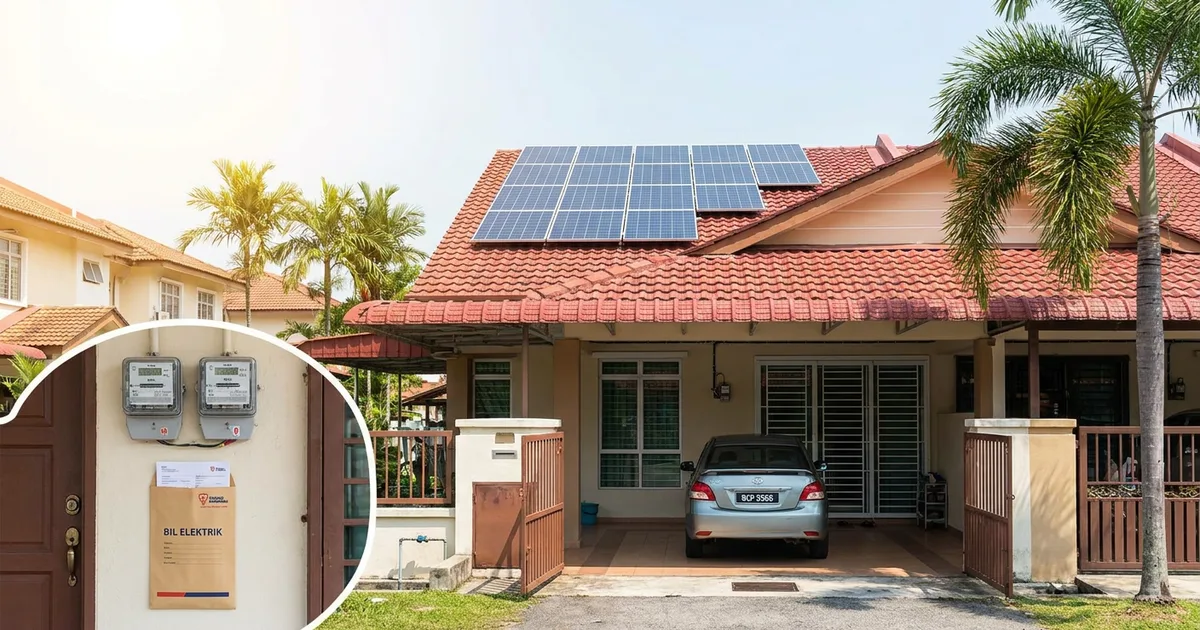
If your TNB bill looked different from July 2025 onwards, a charge labelled AFA, a Capacity Charge, a Network Charge, a base rate you don’t recognise, you are not imagining it. Millions of Malaysian households opened that first restructured TNB electricity bill and found line items nobody had explained, the familiar tiered blocks suddenly gone. The TNB new tariff is the most significant overhaul of the country’s residential electricity billing in years, and it took effect on 1 July 2025.
Here is what each new charge actually means in plain English, whether your household ends up paying more or less, because the answer genuinely depends on how much you use, and the real solar savings maths under the new structure, with ringgit figures rather than a vague gesture toward “solar can help”. The new tariff didn’t just raise bills. It changed the underlying economics of generating your own electricity.
What Changed on Your TNB Bill from July 2025
The biggest change wasn’t the price. It was the structure. The old tiered block-rate system, where the first 200 units were cheaper than the next 100, and so on up the ladder, has been scrapped entirely. In its place sits a single flat energy charge of 27.03 sen/kWh for households using up to 1,500 kWh a month. Go above 1,500 kWh and that rate jumps to 37.03 sen/kWh.
Five charges now appear separately on your bill where they used to be bundled into one opaque number: Energy Charge, Automatic Fuel Adjustment (AFA), Capacity Charge, Network Charge, and Retail Charge. The headline figure most people quote is the base tariff rise of 13.64%, from 39.95 sen/kWh to 45.40 sen/kWh. That number is real, but the structure underneath it matters far more than the percentage, as the rest of this post shows.
These rates are not a temporary adjustment. They are locked in under Regulatory Period 4 (RP4), which runs from July 2025 through December 2027. Whatever your 2026 TNB bill says, this is the framework you are paying under right now, and it holds until at least the end of next year, so it is worth understanding properly rather than waiting for it to change.
Here is how the full electricity tariff in Malaysia now breaks down:
| Component | Rate | What it covers |
|---|---|---|
| Energy Charge | 27.03 sen/kWh (≤1,500 kWh) 37.03 sen/kWh (>1,500 kWh) | Core usage charge for the electricity you consume |
| Automatic Fuel Adjustment (AFA) | Variable monthly | Tracks global fuel prices. A surcharge or a rebate. Exempt if you use ≤600 kWh |
| Capacity Charge | 4.55 sen/kWh | Fixed infrastructure cost on every grid unit |
| Network Charge | 12.85 sen/kWh | Grid transmission and distribution cost |
| Retail Charge | Fixed monthly fee | Billing and administration |
Now that you know what the five components are, the key question is whether this means your bill goes up or down.
Will Your Bill Go Up or Down? It Depends on How Much You Use
The restructuring sorts households into three clear bands, and where you land decides whether your bill rose or fell.
Protected (600 kWh a month or less). You are fully exempt from AFA surcharges, a deliberate protection for lower-income homes, and you qualify for the Energy Efficiency Incentive worth up to 25 sen/kWh off. Because the old top-tier block rates were higher than the new flat rate, many homes in this band actually see a small reduction. This is the group behind TNB’s headline that 23 million consumers are unaffected.
Mixed (601 to 1,000 kWh a month). You lose the AFA exemption the moment you cross 600 kWh, so every unit now carries fuel-price risk, but you keep the efficiency incentive up to 1,000 kWh. TNB reckons homes up to around 900 kWh a month may still come out slightly ahead overall, but that hinges on AFA staying favourable, so whether you end up ahead or behind in a given month comes down to which way AFA moved.
Most exposed (above 1,000 kWh a month). Full AFA exposure, no efficiency incentive, and the 37.03 sen/kWh rate on everything above 1,500 kWh. This is the large family home with air conditioning running most of the day, a pool pump, or an EV on the charger overnight. These households feel the increase hardest, and they are exactly the homes where solar pays back fastest.
The most confusing new item on those higher bills is the AFA, the charge that changes every single month.
What Is AFA and Why Does Your Bill Change Every Month Now?
AFA stands for Automatic Fuel Adjustment, and it replaced the old biannual ICPT mechanism. The difference matters. ICPT was reviewed twice a year. AFA recalculates every single calendar month, based on global coal and gas prices and the ringgit exchange rate. Your bill is no longer something you can predict, because it now tracks commodity markets you have zero control over. (Our TNB bill calculator shows exactly where the AFA line lands on your own usage.)
The 2026 numbers show exactly how fast this moves. In January 2026 AFA was a rebate of 4.99 sen/kWh, money off your bill. By April the rebate had shrunk. In May it flipped to a surcharge of 1.38 sen/kWh. The direction reversed in the space of five months.
If you use 600 kWh or less, none of this touches you, the AFA surcharge exemption holds. Above that line, every unit you draw from the grid carries this fuel-price risk. For a household using 1,000 kWh a month, that May surcharge of 1.38 sen/kWh adds roughly RM13.80 to a single month’s bill. In a year of sustained global energy price rises, a figure like that compounds into real money.
AFA is one form of grid-price exposure. But there is a second fixed cost, the capacity and network charges, that matters even more for the solar calculation.
The 17.40 sen/kWh Overhead Solar Self-Consumption Avoids (That Energy Saving Tips Don’t)
This is the part of the new tariff that almost nobody explains, and it is the single most important point for anyone weighing up solar.
Add the Capacity Charge of 4.55 sen/kWh to the Network Charge of 12.85 sen/kWh and you get 17.40 sen/kWh. That is a fixed overhead applied to every unit you pull from the grid. It has nothing to do with fuel prices. It has nothing to do with how careful you are. Switching off lights, taking shorter showers, swapping to LED bulbs, all of that trims the energy charge only. None of it touches the 17.40 sen/kWh. That overhead applies to every single grid unit regardless of how efficient your household is.
There is only one way to avoid it: don’t draw the unit from the grid in the first place. Generate it yourself and consume it on-site.
This is where the new structure quietly transformed the solar maths. Under the old tiered system, a household in the lower blocks was only avoiding around 21.80 sen/kWh of bill value for each unit of solar it self-consumed. Under the new flat rate, every self-consumed unit avoids 27.03 sen (energy) plus 4.55 sen (capacity) plus 12.85 sen (network), which comes to 44.43 sen/kWh before AFA is even counted. Add an AFA surcharge on top in a bad month and the avoided cost climbs past 45 sen for every unit your panels feed straight into your home.
One nuance most installers skip: the export side of the equation is not as generous. When your system exports surplus to the grid under NEM or Solar ATAP, the offset reflects the energy component only. It does not include the capacity, network, or retail charges. So the full 5-component rate is avoided only on the units you consume yourself, in daylight, as your panels produce them. A system sized and oriented to maximise daytime self-consumption returns materially more than one built to dump excess onto the grid. That is the difference between a good installer and a quote that just sells you panels.
So what does this look like in actual ringgit? Here is the calculation for the household this tariff hits hardest.
The Solar ROI Maths Under the New Tariff: How Does the New TNB Tariff Affect Solar Savings?
Take the household this tariff actually squeezes: a larger terrace or semi-D using around 1,100 kWh a month. Under the new rates, with full AFA exposure and the capacity and network charges sitting on every unit, that home is paying well north of RM400 a month, and a single bad AFA month pushes it higher.
A 5kW solar system costs roughly RM25,000 fully installed by a SEDA-registered installer. The SuRIA Home cash rebate from TNB takes up to RM3,000 off, bringing the net outlay to about RM22,000. In Peninsular Malaysia, with roughly 4.5 peak sun hours a day, a 5kW array generates around 600 to 675 kWh a month, covering the bulk of that home’s daytime load, which is exactly where self-consumption avoids the full 44-plus sen/kWh.
The monthly saving lands at roughly RM300 to RM400 once self-consumption and export offset are combined, and it climbs in the very months AFA spikes. At that rate the system pays for itself in about five to seven years. Over a 25-year panel lifetime, the savings stack up to somewhere between RM90,000 and RM105,000, an annual return in the region of 12 to 18%.
Set that against the alternatives. A fixed deposit returns a few percent and offers no protection against rising energy costs. A RM22,000 solar investment throwing off RM300 or more a month is a 12 to 18% annual return with a built-in hedge against every future AFA surcharge and every tariff revision in the next regulatory period after 2027. The headline most installers lead with is a 70 to 80% cut in your electricity cost, and for a well-matched system on a sunny roof, that holds up.
These figures are estimates. Actual savings depend on roof orientation, shading, the size of the system, and your usage pattern, which is why a site assessment matters more than a generic quote. You can get a rough starting figure yourself with our solar savings calculator before you speak to anyone, then compare SEDA-registered installers for a proper assessment.
To actually capture these savings, you need a programme that lets you connect your system to the grid. NEM is closed, but its replacement is open right now.
Solar ATAP 2026: No Quota, Open Access (NEM Is Closed, Use This Instead)
If you have read older solar articles, you have probably seen NEM Rakyat mentioned as the way to go solar. That advice is now out of date. The NEM Rakyat Quota 3.0, a 2,500 MW pool, was fully subscribed and closed in June 2025. Any post still telling you to apply for NEM is giving you outdated information.
The replacement launched on 1 January 2026: the Solar Accelerated Transition Action Programme, or Solar ATAP. The crucial difference is that Solar ATAP has no fixed national quota. Applications are accepted on a rolling basis, so the “the quota ran out, I missed my chance” problem that locked out latecomers under NEM simply does not exist anymore.
Solar ATAP keeps the 1-for-1 energy offset that made NEM worthwhile, so surplus units you export are credited against your bill on a one-to-one basis. SEDA administers the programme, and you must apply through a SEDA-registered installer. That is the one gate, and it is there to protect you. For the full detail on how the two schemes compare, read our full Solar ATAP vs NEM Rakyat comparison. The official programme page also sits at seda.gov.my/reportal/atap if you want to read the guidelines straight from the source.
For context on how fast Malaysia is moving, rooftop solar reached 1.72 GW of installed capacity by July 2025, around 40% of all installed solar in the country. The new tariff has only sharpened the case for joining it.
Where This Leaves You
So here is where you stand. The TNB new tariff added a 17.40 sen/kWh overhead you cannot trim with efficiency, an AFA charge that moves with global fuel markets every month, and a flat rate that makes every self-consumed solar unit worth more than it used to be. If you are in the higher-usage group, that combination is costing you, and it will keep costing you through the end of RP4 in December 2027.
Solar self-consumption is the one structural hedge against all of it. Solar ATAP is open with no quota, the RM3,000 SuRIA Home rebate is available now and cuts straight off your upfront cost, and the only thing standing between you and a real number is a quote. You can verify the official rates any time at mytnb.com.my/tariff.