Every solar company blog will tell you the TNB Time-of-Use tariff is a no-brainer. None of them will show you the household profile where switching makes your bill go up.
That household exists, and if it is yours, the off-peak discount everyone keeps talking about will not save you a single ringgit. TNB says 85% of households will pay similar or less under the new tariff structure. The honest question is not whether that figure is true. It is which 85% you fall into, and whether your daily routine puts you in the group that wins or the group that quietly loses.
People are already using it: more than 70,000 Malaysian households had opted into ToU by late 2025. That sounds like a lot until you set it against TNB’s roughly 9 million domestic accounts, which tells you most people are either unaware of the scheme or, sensibly, unsure it suits them. This guide gives you a verdict, not just an explanation. You will see the actual rates, three real household profiles including one that should stay put, the warning no competitor mentions, and why solar owners get the strongest case of anyone.
What Is the TNB Time-of-Use Tariff?
TNB launched its Time-of-Use tariff on 1 July 2025, the first time dynamic pricing has been offered to Malaysian households. The logic behind it is straightforward. Electricity costs more to generate during periods of peak demand, when offices, factories and homes all draw power at once, and less when the grid is quiet. Rather than charging every unit at the same blended average, ToU passes that variable cost on to you, with a discount for off-peak usage and a premium for peak usage.
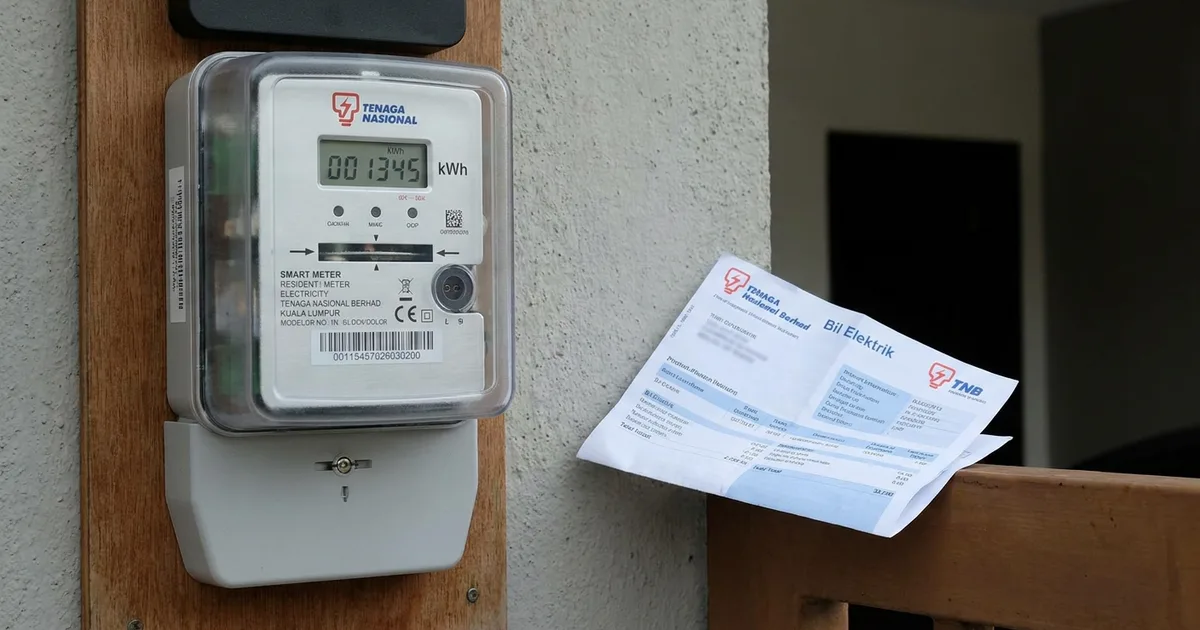
It is not automatic. ToU is opt-in, which is exactly why only 70,000 households have signed up so far. You choose it, and you can choose to leave it. It also requires a smart meter to measure your consumption hour by hour. TNB had installed more than 5 million smart meters by late 2025 and is targeting 9 million across Peninsular Malaysia by the end of 2026.
One eligibility point catches people out: ToU only applies to Peninsular Malaysia, where TNB is the utility. If SESB serves you in Sabah or SESCO in Sarawak, the scheme is not open to you at all. That settles the what and the where. The part that actually decides your bill is the when, so the schedule is where we go next.
Peak and Off-Peak Hours: The Schedule That Determines Your Bill
The entire tariff rests on two time bands, and they are not evenly matched. Peak runs from 2:00 PM to 10:00 PM, Monday to Friday only. That is eight hours a day. Everything else is off-peak.
Off-peak covers 10:00 PM to 2:00 PM on weekdays, a full 16 hours, plus the whole of Saturday, Sunday and every public holiday. Read that again, because it is the most important fact in this article. Sixteen of every 24 weekday hours are already off-peak before you change a single habit, and weekends are entirely off-peak around the clock.
What that means in practice depends on when your appliances run. Put the washing machine, dishwasher or EV charger on after 10pm or before 2pm, and every one of those units costs less under ToU than it would on the General Tariff. Run the air conditioning from noon until 9pm on a weekday, and you are sitting inside the peak window for most of that stretch, paying the premium. Knowing the schedule is step one. The rates tell you how much each side of that line actually costs.
TNB ToU Tariff Rates 2025/2026: The Numbers You Need
Here is the data people are searching for, laid out cleanly. The table below shows the ToU energy charge against the General Tariff baseline, split by the two usage brackets TNB uses.
| Monthly Usage | ToU Peak (2pm to 10pm weekdays) | ToU Off-Peak (all other times) | General Tariff (flat) |
|---|---|---|---|
| ≤1,500 kWh | 28.52 sen/kWh | 24.43 sen/kWh | ~27.03 sen/kWh |
| >1,500 kWh | 38.52 sen/kWh | 34.43 sen/kWh | ~37.03 sen/kWh |
Source: TNB domestic ToU schedule via Single Buyer, July 2025 rates. Energy charge only. Verify the current figures on the official TNB tariff page before you switch, as rates are reviewed periodically.
The maths that actually decides whether you save sits inside that table. In the ≤1,500 kWh bracket, ToU peak energy costs 1.49 sen/kWh more than the General Tariff. Off-peak costs 2.60 sen/kWh less. The saving per unit you shift out of peak and into off-peak is 4.09 sen/kWh, the gap between 28.52 and 24.43. To come out ahead, the units you move off-peak have to outweigh the units you still burn at the higher peak rate.
Two more things sit on top of every domestic bill, ToU or not. A Capacity charge of 4.55 sen/kWh and a Network charge of 12.85 sen/kWh apply to all consumption. There is also a Retail charge of RM10 a month, which is waived if your total monthly usage stays at or below 600 kWh. Switching to ToU costs a one-time RM10 stamp duty.
To put real numbers on it, a household that successfully shifts 400 kWh of usage into off-peak hours saves roughly RM10.40 a month against the General Tariff. That is a useful gain if your routine allows it, and nothing at all if it does not. The numbers make sense in theory. The question is what they mean for your specific household.
Three Household Profiles: Who Benefits, Who Breaks Even, Who Shouldn’t Switch
No competitor in the top results runs the maths on a household that loses money under ToU. We will, because pretending everyone benefits is how people end up worse off. Here are three real profiles with a clear verdict for each.
Profile A: The night-shift household or remote worker. Switch. If 70% or more of your consumption lands after 10pm or before 2pm, ToU is built for you. The washer, dryer, dishwasher and EV charger all run late evening or early morning, squarely in the 24.43 sen/kWh off-peak band. The handful of units you still use during peak cannot outweigh that discount across the month. A 600 kWh home that keeps roughly three quarters of its usage off-peak clears RM10 to RM40 a month depending on total volume, with the saving growing the more load you can push into the cheap hours.
Profile B: The solar owner on NEM Rakyat. Switch, and this is the strongest case of all. Your panels already generate through the opening hours of the 2pm peak, so ToU turns daytime solar from a behavioural saving into a structural one: the system offsets the most expensive electricity of the day on its own, whether or not you are home. The full mechanics, including how NEM Rakyat export credits behave under ToU, are in the next section.
Profile C: The stay-at-home family with daytime air conditioning. Stay on General Tariff. Kids home from school means the air conditioning runs from around noon to 8pm, six of the eight peak hours, every single weekday. Add cooking, ironing and the evening TV, and most of your consumption lands inside the premium window. Here is the line that decides it: ToU only wins if less than 63.6% of your usage falls inside the peak window, because below that threshold the 2.60 sen off-peak discount outruns the 1.49 sen peak penalty. A 700 kWh household with roughly 70% of its usage in peak pays about RM2 a month more on energy alone, and that is before it forfeits the EEI rebate it currently collects on the General Tariff. Switch and the bill goes up, not down. This is the profile the solar company blogs never mention, because there is nothing to sell the household that should not move. If you have solar, or are seriously considering it, there is one more layer to this calculation that changes the numbers significantly.
Solar + ToU: Why This Combination Is Different
For most households, ToU is a behavioural play. You save by changing when you run things. Solar changes that entirely, because the system does the shifting for you while you are at work.
A typical 3kWp solar system in Malaysia generates 9 to 15 kWh a day, with output building through the morning, peaking between 9am and 3pm, and tailing off into the late afternoon. The ToU peak window opens at 2pm. So across the early part of that peak, roughly 2pm until your panels fade in the late afternoon, they are actively producing exactly when grid electricity is at its most expensive. Every unit you self-consume during peak is a unit you avoid buying at 28.52 sen/kWh. That avoided cost is 1.49 sen/kWh higher than it would be on the General Tariff, which makes each self-consumed unit more valuable under ToU, not less.
The export side stacks on top. Under the NEM Rakyat programme, surplus energy you push to the grid during peak hours is credited at the peak rate, lifting your effective feed-in offset above what the General Tariff would return. Battery storage extends the benefit into the 6pm to 10pm evening peak by releasing stored daytime generation after the sun drops, though it is not required to come out ahead.
If you do not have solar yet, ToU quietly strengthens the case for it. By putting a premium on peak electricity, ToU raises the value of every unit a future system would offset during daylight, which improves the payback maths. This is why getting the system size right matters so much. The right capacity for your usage pattern decides how much of that peak window your panels actually cover. You can model the export side yourself with the official SEDA NEM Calculator, or estimate a system sized to your bill using our solar savings calculator. Before you switch, there is one thing almost every article on this topic gets wrong, and it could mean you pay more, not less.
The EEI Warning: What Nobody Else Is Telling You
Here is what the solar company blogs will not tell you. The Energy Efficiency Incentive, or EEI, is a rebate available under the General Tariff for households using 1,000 kWh a month or less. It is worth up to 25 sen/kWh at the most efficient bands and reduces bills by anywhere from 1% to 15% depending on which usage band you sit in, from 50 kWh users up to 900 kWh users.
The EEI is not available on ToU. Switch, and you forfeit it. That single fact is missing from every competing guide we reviewed, and for low-usage homes it can be decisive.
Stack it up. A household using under 600 kWh a month already has the Retail charge waived, may benefit from the AFA waiver, and collects the EEI rebate on top, all under the General Tariff it is already on. A home in that band is giving up a rebate worth several ringgit every month, money the General Tariff quietly hands back and ToU does not, on the bet that off-peak shifting will more than replace it. For a daytime household that bet rarely pays. If you use less than 600 kWh a month, run the full bill comparison before you switch. Your current tariff is probably better than it looks. With all that in mind, here is a clean decision framework.
Should You Switch to TNB ToU Tariff? A Checklist
Be honest with yourself about your usage pattern. This tariff rewards self-awareness, not optimism. Switch to ToU if most of these describe you:
- You can move the washing machine, dishwasher and EV charging to after 10pm or before 2pm
- You already have solar panels, or are installing them this year
- You use more than 600 kWh a month, so the EEI and waivers are not protecting you anyway
- You charge an electric vehicle overnight on a regular basis
Stay on the General Tariff if these are closer to the truth:
- Your air conditioning runs through weekday afternoons and into the evening
- You use less than 600 kWh a month, where the EEI rebate and waivers likely beat ToU
- Your household routine is fixed during peak hours and genuinely cannot shift
The decision is not permanent either way. You can revert to the General Tariff, the same RM10 stamp duty applies again, and reversal is allowed once every 12 months. If you have decided to switch, or just want to try it, the process is straightforward.
How to Switch to TNB ToU Tariff (Step by Step)
You need to be a TNB domestic customer in Peninsular Malaysia with an active smart meter. Check whether your meter is a smart meter inside the myTNB app. Once that box is ticked, you have three ways to apply.
- myTNB app. Go to Manage Account, then Tariff, then Switch to ToU. This option has been live since 1 August 2025 and is the fastest route.
- Email. Send the completed application form together with a copy of your MyKad to TNB customer service. The current address is listed on the official TNB tariff page.
- Walk-in. Visit any Kedai Tenaga service centre and apply in person.
The switch costs a one-time RM10 stamp duty. If your smart meter is already active, processing takes about 5 working days. If you do not have a smart meter yet, you can still apply, but TNB has to install one first, so expect a wait of around 2 months before ToU billing begins.
ToU is a tool, not a universal upgrade. Whether it helps you comes down entirely to when you use electricity. For households that can shift load to nights and weekends, it pays. For daytime air conditioning homes and very low users protected by the EEI, the General Tariff often wins, and there is no shame in staying put.
For solar owners, the combination is the most financially powerful option available to a Malaysian household right now, because your panels offset the most expensive hours of the day automatically. Solar and ToU are not two separate decisions. They are one decision that works best together.