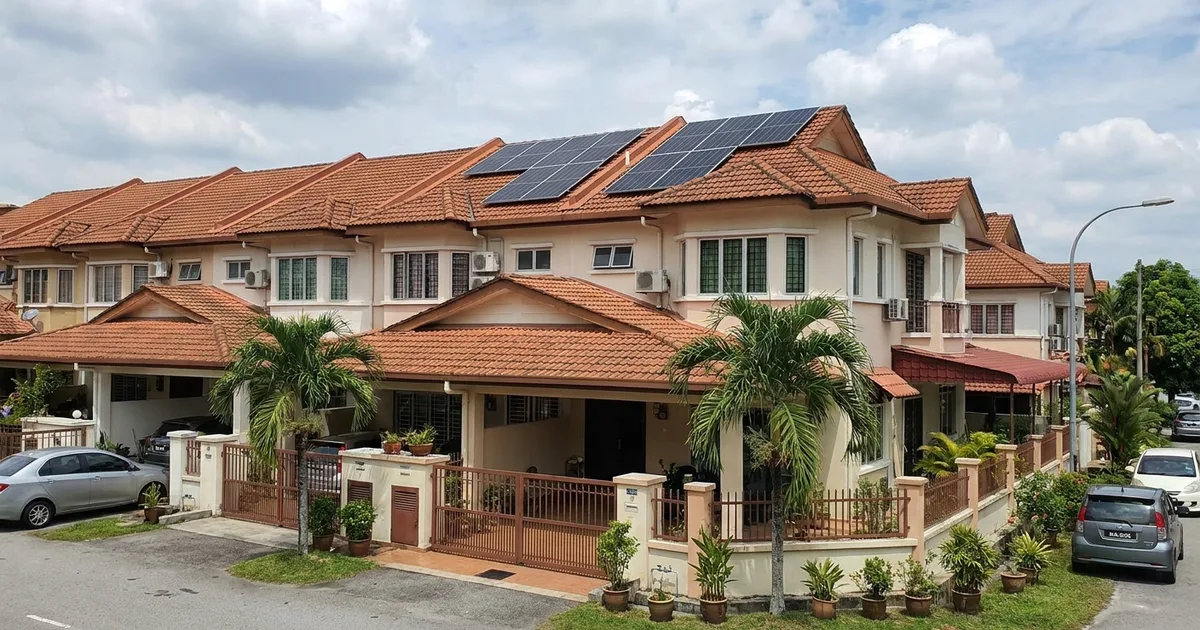
Get three quotes for a 5kWp solar system in Malaysia and you might see RM18,000 from one installer and RM24,000 from another. Same panel brand. Same inverter. Same roof. The difference is not always quality, it is often margin, and information asymmetry is what keeps it there. (For the full line-item breakdown of what an installation should cost, see our cost to install solar panels guide.)
Almost every solar price guide in Malaysia is published by an installer who wants to sell you their system at their number. SolarCompare.my has no installer affiliation, so this guide can say what those guides will not: what a fair solar price in Malaysia actually looks like in 2026 by system size, where the money goes inside a quote, and how to claim the new SuRIA Home rebate that launched on 1 June 2026 and can cut RM3,000 off your net cost. By the time you finish reading, you should be able to open any quote in your inbox and know whether it is fair.
Solar Panel Cost in Malaysia 2026: The Quick Answer
A fully installed residential system costs RM3,000 to RM4,000 per kWp in 2026 for a quality tier-1 setup. That figure covers the panels, the inverter, mounting, wiring, the Solar ATAP application, and the TNB meter work. A quote below RM2,800 per kWp should make you ask what panel model is being used. A quote sitting well above the RM4,000 band needs a clear reason, such as a difficult roof or genuinely premium hardware.
Here is the solar panel price per kW in Malaysia translated into the system sizes most homes actually buy, matched to property type and monthly TNB bill.
| System Size | Typical Installed Price | Best Fit |
|---|---|---|
| 3 kWp | RM12,000–RM15,000 | Small terrace, RM100–200/mo TNB |
| 5 kWp | RM16,500–RM22,000 | Standard terrace, RM200–350/mo TNB |
| 6.6 kWp | RM18,500–RM30,000 | Medium terrace or small semi-D |
| 8 kWp | RM24,000–RM32,000 | Semi-D, RM350–500/mo TNB |
| 10 kWp | RM30,000–RM40,000 | Semi-D or small bungalow |
| 15 kWp+ | RM45,000–RM65,000+ | Bungalow or high-consumption home |
These are market benchmarks, not installer quotes. Carrying them in your head turns every conversation into a comparison instead of a guess. In Bahasa Malaysia this is what people are searching when they type harga solar panel Malaysia, and the ranges above are the answer.
What You’re Actually Paying For: The Cost Breakdown
The solar installation cost in Malaysia breaks into six parts. Knowing roughly what share each one should take is what lets you read an itemised quote properly instead of guessing whether a line is fair. Here is how a typical quote divides up.
| Component | Share of Cost | What Drives It |
|---|---|---|
| Solar panels | ~40% | Brand, technology, wattage |
| Inverter | ~25% | String vs micro vs hybrid, warranty |
| Installation labour | ~10% | Roof access, distance from base |
| Mounting structure | ~10% | Flat-roof ballast vs pitched-roof rafter |
| Cabling and electrical | ~10% | Isolators, breakers, DB upgrade |
| Permits and SEDA fees | ~5% | Solar ATAP application, TNB registration |
The panels are the biggest single variable, but the inverter is the choice that decides your long-term return. There are three types and they are not interchangeable. A string inverter is the cheapest and the most common, and it suits a clean unshaded roof. Microinverters sit on each panel, handle shade far better, and carry a 20 to 30% price premium. A hybrid inverter is battery-ready and adds RM2,000 to RM5,000 to the system, which only makes sense if a battery is on your roadmap.
Labour is the line that moves most with your specific home. A single-storey house with a flat roof is quick and cheap to fit. A two-storey home with a steep pitch eats more crew hours and more safety rigging, and the quote reflects it. If your roof differs from your neighbour’s, your number will too.
The permits and SEDA fees are fixed at roughly 5% and are non-negotiable, because they are government and utility charges, not installer revenue. If a quote inflates this line to RM2,000 or more, treat it as a flag worth questioning.
Panel Brands Compared: LONGi, Jinko, Trina and the N-Type Difference
The Malaysian market runs almost entirely on Chinese tier-1 modules, and the dividing line that matters is N-type versus the older P-type. N-type panels such as the Jinko Tiger Neo, LONGi Hi-MO X6, and Trina Vertex S+ cost 10 to 15% more upfront. In Malaysia’s climate that premium earns its keep, because N-type cells degrade slower and hold their output better in the sustained heat of a Malaysian afternoon, when a rooftop runs far hotter than the air around it.
| Brand & Model | Efficiency | Warranty | Tier | Notes |
|---|---|---|---|---|
| LONGi Hi-MO X6 | 22.1–23.0% | 30-year | Premium | Best temp coefficient (-0.26%/°C) |
| Jinko Tiger Neo | 21.5–22.5% | 25-year | Mid-premium | Low degradation, ~0.4%/yr |
| Trina Vertex S+ | 21.0–22.0% | 25-year | Mid | Reliable mainstream pricing |
| Canadian Solar HiHero | 21.4–22.0% | 25-year | Mid | Strong local presence |
| Risen / Seraphim (P-type) | 19.5–20.5% | 25-year | Budget | Fine for simple, unshaded roofs |
LONGi has the best temperature coefficient of any mainstream brand at -0.26% per °C, which is exactly the spec that matters when a Malaysian roof bakes all day. Budget P-type panels from Risen or Seraphim are acceptable on a simple rooftop with no shade, but they give up output in partial shade and degrade faster.
So the practical takeaway is this: an installer quoting RM2,500 per kWp is almost certainly fitting budget P-type panels. That is not a cheaper version of a tier-1 N-type system, it is a lower-spec product that will generate less over its life, and it should be priced and judged as one. Ask for the exact model before you compare it against anything else.
Solar ATAP Explained: How Export Credits Work in 2026
NEM 3.0 closed at the end of June 2025. Solar ATAP replaced it from 1 January 2026, run by PETRA through SEDA with TNB as the offtaker. Any installer still describing “NEM” as a current programme is working from out-of-date information, and that should make you wonder what else is out of date.
Two things changed that affect your wallet. First, Solar ATAP has no quota cap. Applications are open indefinitely, so the old race to apply before the national quota filled is over. Second, the export credit is now tiered. If your monthly consumption is 1,500 kWh or less, exported units are credited at RM0.27 per kWh. Above 1,500 kWh per month, the rate rises to RM0.37 per kWh. You sign a 10-year export contract with TNB.
The number that should change your behaviour is the gap between exporting and self-consuming. A unit you use the moment you generate it displaces grid electricity at the full retail tariff, which runs RM0.21 to RM0.57 per kWh depending on your usage tier. A unit you export back to the grid earns only RM0.27 to RM0.37. Self-consumption is always worth more than export.
That single fact has a practical consequence: size your system to your consumption, not to your roof capacity. A system that pumps out far more than you use will export the surplus at a credit rate below what the grid charges you to buy power back at night. For the full scheme breakdown, see our Solar ATAP vs NEM Rakyat guide, or check the official details on the SEDA ATAP portal.
SuRIA Home Rebate: RM3,000 Off, But the Quota Will Run Out
PETRA opened the SuRIA Home rebate for applications on 1 June 2026, and it is the single best timing lever available to a Malaysian solar buyer right now. The rebate pays RM600 per kWac of installed capacity, up to RM3,000 total per household. It is a cash rebate, not a tax credit, so the RM3,000 comes straight off your actual out-of-pocket cost rather than off a future tax bill.
The catch is the quota. The scheme is capped at 250MW nationally on a first-come, first-served basis. When that capacity is allocated, the rebate is gone. To qualify you must use a SEDA-registered installer, which is one more reason to verify an installer’s credentials before you sign anything.
There is a second clock running too. China removed its 13% VAT export rebate on solar products in April 2026, and because roughly 80% of the panels fitted in Malaysia are Chinese-made, landed module prices have already ticked up and are expected to climb further through the second half of the year. So the timing logic stacks: install now and you capture the RM3,000 before the quota fills, and you lock in today’s hardware price before the next rise. Waiting costs you on both.
The real-money effect is large. A 5kWp system quoted at RM19,500 drops to an effective RM16,500 once the full RM3,000 rebate is applied, and that cut shortens your payback by roughly half a year to a full year. A buyer who applies now captures it. A buyer who waits until the quota fills pays the full RM19,500 for the identical system. The fastest way to lock it in is to line up a SEDA-registered installer through SolarCompare.my and get the application moving before the quota closes.
Payback Period and ROI: Real Numbers
For most residential systems, payback runs 4.5 to 6 years, and with the SuRIA Home rebate applied you should expect the lower end of that range. The annual return works out to 18 to 22%, which comfortably beats a fixed deposit or an EPF dividend. Here is what that looks like across the common system sizes.
| System | Installed Cost | Monthly Saving | Payback |
|---|---|---|---|
| 3 kWp | RM13,500 | RM180–220 | ~5–6 years |
| 5 kWp | RM19,500 | RM280–320 | ~5–5.5 years |
| 8 kWp | RM28,000 | RM450–520 | ~4.5–5 years |
| 10 kWp | RM33,000 | RM550–650 | ~4.5–5 years |
A real example makes this concrete. A homeowner in Shah Alam fitted a 4kWp system and watched the monthly TNB bill drop from RM420 to RM98. That is RM322 saved every month, around RM3,864 a year, on a system that keeps producing for two more decades. A well-sized 5kWp setup saves roughly RM300 a month and a 10kWp around RM600.
The 20-year view is where solar stops looking like a big cheque and starts looking like an obvious one. Take that 5kWp system at an effective RM16,500 after the rebate: across two decades of TNB savings and export credits it returns well over RM100,000 in total, comfortably more than six times what you put in. Panels lose only about half a percent of output a year, so the system you buy in 2026 is still doing most of its job in 2046.
How to Finance Your Solar System (and the Rent-to-Own Trap)
A cash purchase has the best long-term ROI because you pay no interest and own the system outright from day one. Most buyers do not need to pay all cash, though, and three other routes are worth knowing.
- EPF Account 2 withdrawal. The most underused option in Malaysia. Workers can withdraw from EPF Account 2 to fund a home solar system, which lets you use savings you already hold rather than taking on a loan.
- GTFS green loans. Government-subsidised interest rates for green technology through participating banks. You spread the cost over 5 to 10 years while staying close to cash-flow neutral, since the energy savings offset the repayment.
- Hire purchase or 0% instalment plans. Offered by some installers over 24 months. Suits buyers who have the income but not the lump sum.
Then there is rent-to-own, and this is where an honest comparison matters. It looks like RM0 upfront, which is the whole pitch. But paying roughly RM3,000 a year for 10 years is RM30,000 in total, against about RM19,500 to buy the same system outright. That is a premium of around RM10,500 for the convenience of no deposit. The platforms promoting rent-to-own will not put those two numbers next to each other, so do it yourself before you sign. Whatever route you choose, one thing matters more than the financing: the installer you sign with.
Red Flags in a Solar Quote
This is the checklist no installer will hand you. Run every quote you receive through it.
- A price below RM2,800 per kWp. Ask for the exact panel model and efficiency rating. Budget P-type panels look identical to N-type on a one-line quote, and the cheap number usually hides cheap hardware.
- No site survey before quoting. Roof condition, shading, and mounting complexity all change the real cost. A quote produced without a site visit is a guess, and guesses get revised upward after you have signed.
- The inverter brand is not named. “Hybrid inverter” is a category, not a brand. Demand the specific model and its warranty term before you compare anything.
- No mention of inverter replacement. A string inverter lasts 10 to 12 years while the panels last 25, so budget RM3,000 to RM6,000 for a mid-life replacement. A quote that pretends this cost does not exist is not telling you the whole story.
- SEDA registration not mentioned. Solar ATAP and the SuRIA Home rebate both require a SEDA-registered installer. If the installer never raises it, ask for the registration number and verify it.
One more thing that is not a red flag but does shift your baseline: if you are in Sabah or Sarawak, expect quotes 10 to 20% above Peninsula rates because of logistics, and do not benchmark an East Malaysia quote against a Peninsula friend’s number. Budget RM500 to RM1,000 a year for cleaning too, since dirty panels lose 10 to 25% of their output.
You now know the real price ranges, where the money goes, how Solar ATAP pays you, and how to claim the RM3,000 SuRIA Home rebate before the quota fills. The last step is the one that protects all of it: never judge a quote in isolation.
The fastest way to know whether a quote is fair is to have something to compare it against. SolarCompare.my matches you with up to three SEDA-registered installers, free and with no obligation, so you can compare quotes, ask each installer the same questions, and decide on your terms. Get your 3 quotes in 2 minutes and you will have real numbers for your own roof before the rebate quota runs out.