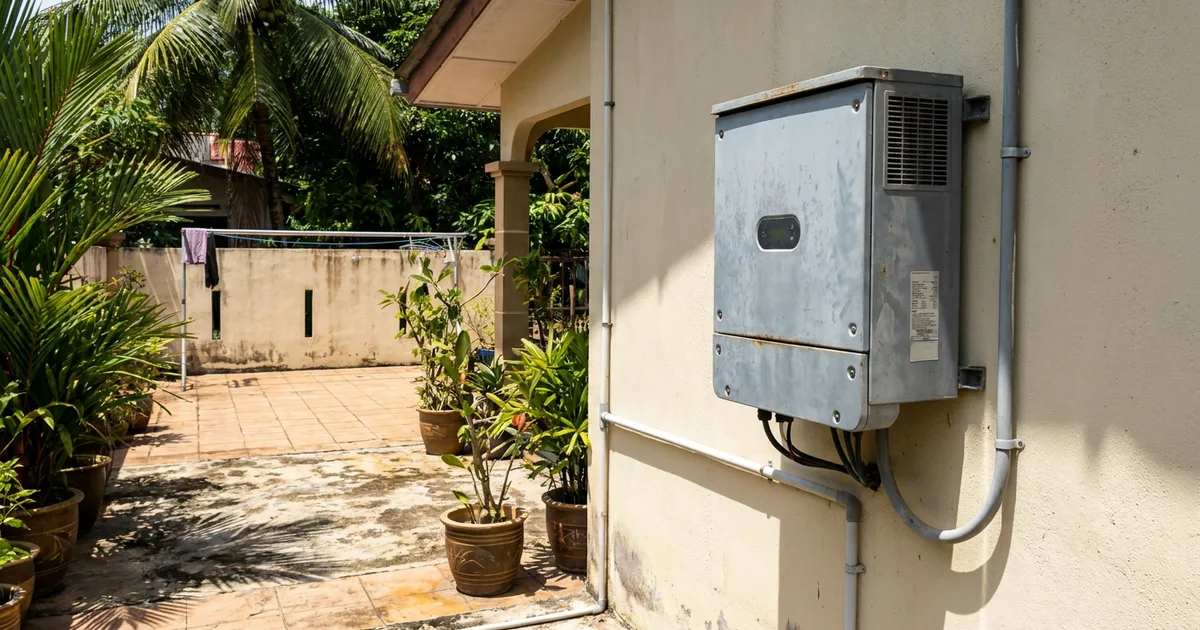
Most Malaysians getting a solar quote focus on getting the biggest system they can afford. Under Solar ATAP 2026, that instinct could cost you thousands in forfeited export credits, not save you money. Choosing a solar inverter in Malaysia is now a financial decision as much as a technical one, and the rule that made it so took effect in January 2026.
It hits the inverter decision hardest, because the inverter is what sets your system’s real output. Size it for your total monthly bill rather than your daytime usage, and under the new rules you generate power you then hand to TNB for free. This guide walks the three decisions you need to make before you accept any quote in 2026: which of the four inverter types fits your property, which brands are actually worth buying here, and how to size the unit so the new export rule works for you instead of against you.
What a Solar Inverter Does (And Why It Matters More Than You Think)
Your panels produce direct current. Your house and TNB’s grid run on 50 Hz alternating current. The inverter is the box that converts one into the other, and without it the panels on your roof power nothing at all.
That makes it the part of the system that does the actual work, but its job goes further. The inverter governs how much usable output you really get, what monitoring you can see on your phone, how the system stays compliant with TNB grid rules, and which warranty terms you inherit. At roughly 20 to 25% of total system cost it is also a real slice of the budget, which makes it the biggest component decision you make after the panels themselves.
Malaysia crossed 5,777 MW of installed solar by the end of 2025, which means no shortage of installers competing for your roof. More installers also means more variation in what they put on your quote, and the inverter is where that variation hits hardest. So it pays to know what you are looking at before you sign. Start with the four types on the market and which one actually fits your property.
The 4 Types of Solar Inverters in Malaysia, With Real Pricing
String inverters are the default for Malaysian residential installs, and for good reason. Your panels wire together in series into one central unit, which keeps the hardware simple and the cost down at roughly RM3,000 to RM5,000. They are the right fit for an unshaded terrace or semi-D with a single roof plane, which describes most landed homes in the Klang Valley and beyond. The one real weakness is that a single shaded panel drags down the output of every panel on that string, so they suit clear roofs best.
Microinverters sit under each individual panel and convert DC to AC at the module itself, which costs more at around RM5,000 to RM8,000 or higher. They are the correct answer when shade is unavoidable: a water tank on the roof, a mature tree next door, a party wall on a link house, or a complex multi-plane roof. Because each panel reports separately, faults are trivial to isolate, and a shaded panel no longer pulls the rest down. They are still growing slowly in Malaysia because of the upfront premium, but for the right roof they earn it.
A hybrid solar inverter in Malaysia adds a built-in battery charge controller, so it can store surplus generation instead of exporting it. That matters more under Solar ATAP 2026 than it used to, because excess daytime power you would otherwise forfeit can be banked for use after dark. The catch is battery economics. A usable home battery runs RM15,000 to RM35,000, and the battery component alone pays back over roughly 8 to 12 years at current TNB tariffs, so it is a deliberate financial decision, not a default upgrade.
Central inverters are industrial and utility-scale units above 500 kW, and they have no place on a home or SME roof, so you can ignore them entirely.
The honest take for most readers: if you have a clear, unshaded roof on a typical terrace or semi-D, a string inverter is the correct starting point. Microinverters are a shade solution, not a status upgrade, and paying for them on a roof that doesn’t need them is money you could have put toward better panels. The rule for when to pay the premium is simple. If more than one or two panels will sit in shade for part of the day, or your roof faces three or more directions, microinverters usually earn their keep. Otherwise they don’t. Across all types, expect the inverter line on your quote to land somewhere between RM2,500 and RM10,000, inside a typical all-in 5 to 8 kW system of RM17,900 to RM26,900. Once you’ve decided on type, the next question is brand. This is where Malaysian buyers are most uncertain, and where bad advice is most common.
Best Solar Inverter Brands in Malaysia, Ranked by Verified Data
Most brand advice you’ll read here is just the installer telling you what they happen to stock. This table is anchored to something verifiable instead: Wood Mackenzie’s H1 2025 global inverter ranking, cross-checked against what each brand’s service network actually looks like on the ground in Malaysia. The global score tells you who builds reliable hardware; the local-service column tells you who can actually fix it when it fails in year seven.
| Brand | Global Rank (WoodMac H1 2025) | Malaysia Position | Warranty (standard / extended) | Price Band (indicative RM*) | Local Service |
|---|---|---|---|---|---|
| Huawei FusionSolar | #1 (score 93.9) | Very high, residential + C&I | 10 yr / up to 20 yr | Mid to high (RM4,000 to 6,000) | Yes, MY distributor network |
| Sungrow | #2 (score 93.7) | Very high, residential + C&I | 10 yr / up to 20 yr | Mid (RM3,500 to 5,500) | Yes, strong MY presence |
| SMA (Germany) | #3 | Premium niche | 5 yr / 10 to 25 yr | High (RM6,000+) | Limited |
| Fronius (Austria) | #4 | Premium niche | 5 yr / 10 yr | High (RM6,000+) | Limited |
| Solis (Ginlong) | #5 | Popular value pick | 5 yr / 10 yr | Low to mid (RM3,000 to 4,000) | Via distributor |
| Goodwe | Mid-tier | Common entry point | 5 yr | Low to mid (RM3,000 to 4,000) | Via distributor |
| Growatt | Mid-tier | Common entry point | 5 yr | Low (RM2,500 to 3,500) | Via distributor |
*Indicative price for a residential-scale unit, based on Malaysian market ranges. Actual quotes vary with capacity and installer.
Huawei FusionSolar sits at #1 globally with a Wood Mackenzie score of 93.9 out of 100 and a 26.4% world market share. It dominates both residential and commercial installs here, backed by a real local distributor network and the FusionSolar monitoring app. Warranty runs 10 years standard with extensions up to 20.
Sungrow is right behind at #2, scoring 93.7 with a 16.7% global share, and its Malaysian presence is very strong. Its iSolarCloud app handles monitoring, warranty matches Huawei at 10 years rising to 20, and installers routinely recommend it alongside Huawei. For most buyers the choice between the two comes down to which one your shortlisted installers service best locally.
Solis ranks #5 globally and is the value pick that actually holds up. Warranty is 5 years standard and 10 extended, the price band is lower, and it reaches the market through a distributor network. If budget is the binding constraint, this is the brand to look at first.
Goodwe and Growatt show up on lower-cost installs as the entry tier, with Growatt’s range spanning 0.75 to 253 kW. Both carry a 5-year standard warranty. They are acceptable, but check local service availability carefully before you commit, because a warranty is only as good as the support behind it.
SMA and Fronius are the European premium tier with excellent engineering reputations and prices to match. The problem in Malaysia is after-sales: their local service infrastructure is thin compared with Huawei or Sungrow, so a long warranty is harder to actually use. Worth the premium only if local service genuinely isn’t a concern for you.
Two things to keep in mind. First, every top-10 manufacturer now offers warranty extensions of 20 years or more, so don’t judge a brand on its 5-year standard figure alone. Second, only inverters on SEDA’s recognised manufacturer listing can be used in an ATAP-registered install, so any reputable installer will only quote compliant brands. Treat that as a quality gate, not a point of difference.
For most Malaysian homeowners, Huawei or Sungrow is the right call, because they have the local service depth to make a 10 to 20 year warranty mean something. Solis is the legitimate value option. Goodwe and Growatt are fine with extra scrutiny on service.
How to Size Your Solar Inverter Under Solar ATAP 2026, the Rule That Changes Everything
Start with what changed. Under NEM 3.0, which still covers anyone who applied before 2026, unused export credits rolled over for up to 12 months. Oversizing was tolerable because the credits simply accumulated and offset your bill later. That safety net is gone for new applicants.
Under the Solar ATAP 2026 programme, which governs every new application from 1 January 2026, any export credit you don’t use within the billing cycle is forfeited at month end, a change confirmed in SEDA’s ATAP programme rules. Generate more than you consume and the surplus goes to TNB for free. That single rule flips the optimal strategy: you now size your system, and your inverter, to your daytime consumption, not to your total monthly electricity bill.
The technical rule of thumb stays simple. Your inverter’s rated capacity in kW should match your panel array in kWp, give or take 10 to 15%. Slight undersizing, known as clipping, is a normal and accepted technique in a high-irradiance market like Malaysia, where peak midday output occasionally exceeds what the inverter is rated to pass anyway.
Here is a practical five-step method any Malaysian homeowner can run:
- Pull your TNB bill and note your average monthly kWh and average monthly RM amount.
- Estimate your daytime consumption. A rough rule is 30 to 40% of your total monthly kWh for a household that is mostly out during the day, and higher if anyone works from home.
- Target a system that produces 90 to 100% of that estimated daytime kWh under typical Malaysian irradiance of around 4.5 peak sun hours per day.
- Set the inverter’s rated capacity to your panel array kWp plus or minus 10%.
- If your system goes above 72 kW, the residential NEM cap, TNB requires a mandatory NEM Assessment Study (NEMAS) before connection.
Put real numbers on it. Take a household with a RM300 monthly TNB bill, which works out to roughly 550 to 650 kWh of usage. If most of the family is out during the day, daytime consumption might be only about 35% of that, around 200 kWh a month. At 4.5 peak sun hours, that points to a system of roughly 1.5 to 2 kWp. The same bill would have justified a 4 to 5 kWp system under NEM 3.0, when every spare unit you exported still earned a credit. That gap is the whole point of the new rule: ATAP rewards matching generation to your daytime use, and quietly penalises everything you build on top of it.
If you genuinely want to capture surplus generation rather than forfeit it under ATAP 2026, a hybrid inverter paired with a battery is the only mechanism that does it. Just run the battery economics as a separate decision first, because the storage cost is real and the payback is long.
This is also exactly why getting multiple quotes from different installers matters now more than it did a year ago. Plenty of installers built generous-sizing habits under NEM 3.0, when oversizing did no harm, and not all of them have updated their default recommendation for ATAP 2026. A second and third quote is how you catch one that is still sizing for last year’s rules.
Four Technical Specs to Check on Any Malaysian Solar Quote
You don’t need to be an electrician to vet an inverter quote. Four specs tell you almost everything about whether the unit suits a Malaysian roof.
MPPT inputs. Look for 2 to 4 Maximum Power Point Tracking inputs. More inputs mean more flexibility for a roof with panels facing different directions, or partial shade from a neighbouring structure. Both Huawei and Sungrow offer multi-MPPT string inverters, which is genuinely useful on the complex roof layouts common to Malaysian link and corner-lot houses.
Efficiency rating. Aim for 97% peak efficiency or higher. Most Tier-1 brands land between 97 and 99%. A one-point gap sounds trivial, but losses compound across a 25-year life, so it is worth confirming on the spec sheet.
IP rating and tropical weatherproofing. An inverter mounted outdoors in Malaysian humidity and rain needs an IP65 rating or better. Many manufacturers still recommend a sheltered spot, a carport or utility area, to extend its life, so ask your installer exactly where they plan to mount it.
Monitoring app. Huawei FusionSolar, Sungrow iSolarCloud, and Solis S-Cloud all give you real-time output on your phone. Check the app store rating before you commit, because that app is how you spot a fault and confirm the system is performing to spec.
One last box to tick is grid protection. Anti-islanding is mandatory under TNB rules for every grid-tied install, and every SEDA-listed inverter already complies, so treat it as something to confirm rather than a feature to compare between quotes.
The single most expensive mistake in 2026 is sizing your inverter for last year’s rules. Right-size for daytime use, pick a brand whose service network can outlive the warranty, and check the four specs before you sign anything. When you are ready, the fastest way to pressure-test a quote is to put it next to two others. SolarCompare.my matches you with up to three SEDA-registered installers so you can compare like for like, or start with the free solar calculator to size your own roof first.